

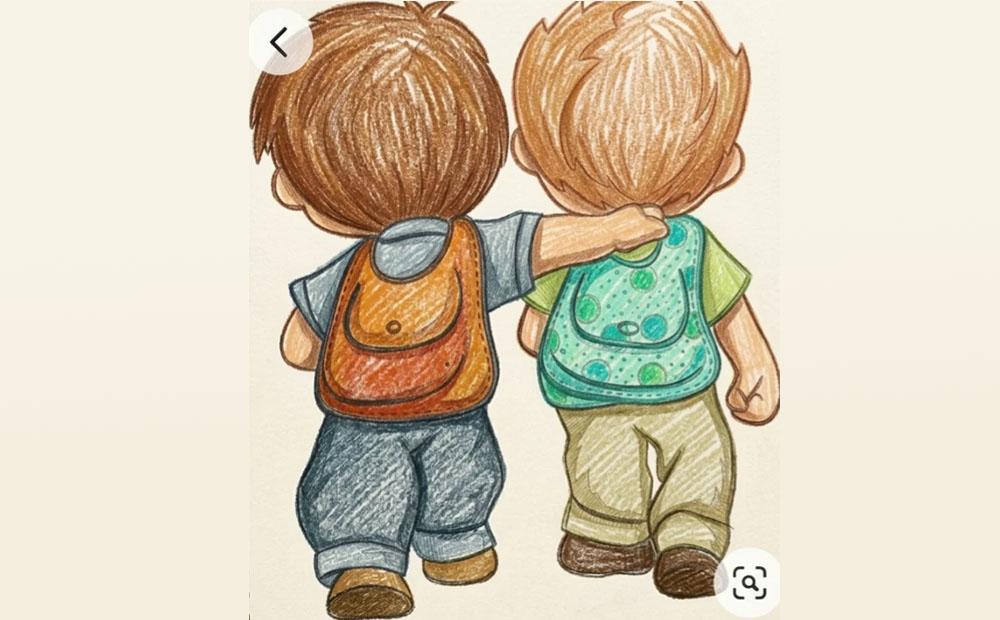
Presentation: The Geography of Belonging
Presentation was never just a school for
me. It was an extension of home. Today, living far away from Calicut, I realize
that in memory, my home and Presentation have merged into one emotional
landscape. Some places become part of us so deeply that we stop separating them
from who we are. Presentation is one such place in my life.
My connection with Presentation probably
began before I was old enough to consciously collect memories. I started my
nursery there, and one of the beautiful things about that beginning is that I
am still in touch with many friends from those early years. In a world before
social media connected us to thousands of people, we built smaller but deeply
meaningful relationships. Families knew one another. Friendships had physical
presence. Childhood had slowness.
Some of my earliest memories are from
those nursery days. I still remember children crying in LKG, including myself.
I can still recall the smell of milk brought in flasks, the aroma of food being
cooked in the afternoon, the sound of classrooms settling down after the
morning chaos. Memory is strange that way. Sometimes it preserves smells and
feelings more vividly than facts.
I even carry a permanent mark from my
years at Presentation. On my passport application, I listed a mark on my
forehead as a birthmark. But the truth is that it was not there when I was
born. It came from a schoolyard accident at Presentation. There used to be a
metal swing in the yard — if I remember correctly, it was green. One day while
pushing another child, I got distracted and the swing hit me straight on the
forehead. I ended up getting stitches, and decades later, the mark still
remains. In some ways, Presentation literally became part of me.
Academically, my early years were not
easy. I was among the youngest in the class, born in the last week of May, and
I struggled to keep up. Eventually, I stayed back one more year in first
standard. I do not remember whether I felt ashamed about it. Maybe I did. Maybe
I did not fully understand it then.
Things became even more complicated
because my family moved frequently due to my father’s work abroad. I missed
second grade entirely while we were in Iran. When I returned in third grade, I
was completely disconnected from studies. If I remember correctly, there were
around forty-five students in the class, and I almost always ranked
forty-fourth or forty-fifth. To this day, I do not know who exactly I was
competing with.
Ironically, my best friend at the time
was usually the first-rank holder. Looking back, I often wonder what my mother
must have thought. I also wonder whether his mother worried about him spending
too much time with me. Those years were difficult. I got into fights, created
trouble in class, and my mother often had to come to school because of my
behavior. If there had been an award for the “worst student,” I might genuinely
have won it.
Today, with the benefit of hindsight, I
think missing a proper second-grade education affected me more than I realized
then. When children are growing, even one year can make a huge difference. We
saw something similar during the COVID years when many young children missed
the structure and social environment of school. Development is not only about
textbooks. It is about rhythm, interaction, confidence, and continuity. I
suspect I lost some of that continuity during those years abroad.
I left Presentation again for three years
when we moved to Dubai. When I returned in 1984 during the final months of
seventh grade, it was another unfamiliar transition. Unlike my earlier years in
Iran, I had at least attended proper schools there, so academics were less of a
struggle. But socially, I felt disconnected. I did not fully understand the
jokes. I could not easily reconnect with classmates in Kerala in the same
natural way. I had also become heavier than before, which made me an easy
target for teasing. Fortunately, that phase did not last long because I was
there only for a few months before moving on again.
Like many students of that time, I
eventually left Presentation after middle school. But even after leaving, the
school remained part of my emotional geography. I think I visited only once
after that. Yet through technology and time, many of us remain connected today
through a small WhatsApp group. It is remarkable how people who shared
classrooms decades ago can still carry fragments of each other’s childhoods.
When I think about Presentation now,
certain images immediately return.
I remember the nursery building and the
adjacent convent where the sisters stayed. I remember the polished floors and
the strange feeling that the area was somehow sacred or out of bounds. I
remember faces more than events — Sister Elizabeth, Miss Sumithra, Sister
Letitia. Years later, after graduating from REC, I remember meeting Sister
Letitia once again. Some teachers and sisters remain frozen in memory exactly
as they were when we were children.
I remember the playground and the giant
wall that seemed enormous to us then. Some of the adventurous boys would jump
down from it onto the sand below. I was never one of the brave ones. In
childhood memory, everything feels larger — the walls, the fears, the
punishments, the friendships.
I also vividly remember the lunchroom,
the back door of the building where students if they were found loitering were
often sent for some punishment, the corridors, the sounds, the atmosphere of
ordinary school life. Ironically, despite spending so many years there, I
remember very little about exams or academic success. Perhaps because I was
never a particularly good student at Presentation.
But maybe schools shape us in ways beyond
marks and ranks.
When I look back now, I realize
Presentation gave me something more important than academic achievement. It
gave me memory, belonging, friendship, and the early experiences that quietly
shape who we become. Life eventually takes us far away — across countries,
professions, and identities — but certain places remain alive inside us.
For me, Presentation will always be one of those places.
Vinod Narayan, California, Tech industry (1987 Batch)